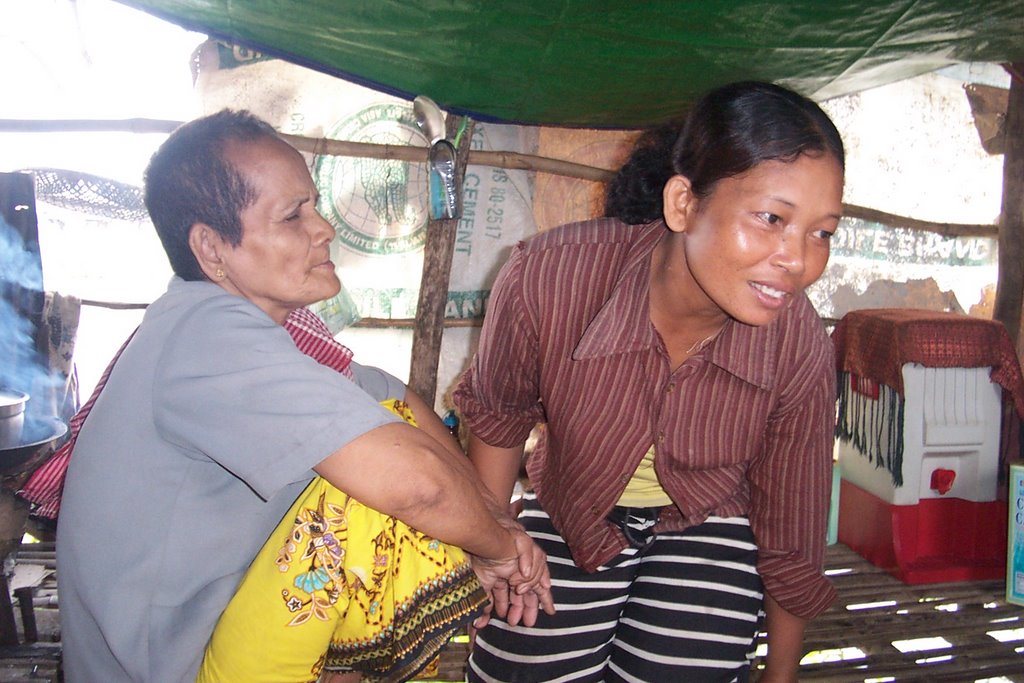
Today, I followed the Hagar Re-integration team to visit two of the women who work with me. The first house was across the river from Phnom Penh city not far from Chhbar Ampov market. We had to cross Monivorng Bridge, to the south of the city. (There are two main bridges in Phnom Penh, the one in the north is the Cambodian-Japanese Friendship Bridge, which takes you across the Tonle (“river”) Sap onwards to Siem Reap. Monivorng Bridge straddles Tonle Bassac and leads you to Ho Chi Minh, Vietnam). Chhbar Ampov market is a big one, where many locals shop on a Saturday morning, and immediately after crossing the bridge I could see a swarm of people, motos and cars.
We drove a short distance and came upon about a dozen shacks built beside a river. This is where Neang (aka Sok Lin) stays. It was very depressing to learn that Neang lives here with her 78-year-old grandmother. She is from Svay Rieng province, just at the border with Vietnam. The only reason Neang has a place to live in Phnom Penh is because she works at a construction site on weekends. The construction company provides these shacks made out of leaves, wood and cement bags (you have to see the photos to understand) for free, along with 30litres of water every day. It sounds a lot, but 30litres of water is not enough to shower and wash with. (To give you an idea, filling a bathtub uses up four or five times as much water). So the clean water is used only for cooking and drinking. Bathing and washing clothes is done at the river. Neang was very hospitable, and offered us her water, while apologizing for not having food to offer us. She told me she earns 6000 riels (less than USD1.50) a day for working as a construction worker. She says it is very hard work, carrying very heavy bags of cement. I have no doubts about it. I have seen women working at a construction site near my house and remember being very surprised. I was surprised they have the strength to do such heavy work.
Neang is a tiny woman. She is 30 years old and divorced. Her husband left her for a friend of hers. The only time she teared when speaking with Chhorvy and me was when she told us how her husband used to beat her (It was my fault. I asked too much). Sometimes she would bleed. She showed us scars on her legs from those bad times. A couple of times it was too much for me and I really had to fight back tears. (At times like this, I recall what I had once read in a book on animal rights when reading about the animal suffering became too painful—if the animal can experience the pain, I certainly can read about it). If Neang had experienced such pain, I can listen to it. But I feel I cannot show I'm upset because I want her to think that things are not that bad. I feel I have to be positive or else she will find it hard to be positive.
Neang may lose her home because since she started working for me, she can only work at the site on weekends whereas they require workers to work at least 3 days a week. She also did not go to work today because she knew I would be visiting. My priority now is to find lodgings for her, preferably in the city. Neang has to pay 2000riels each time she travels to my workshop in the city. That is about USD1 a day on transport. It makes me upset to think that the poor really have it so hard. It is too expensive to live in the city, so they have to live far away. They already earn so little, yet they have to spend a big percentage of their income on transport. Why is there no public transport system?
According to Human Rights Watch, "the highest proportion of government expenditure still goes to security spending even though the war ended long ago. In 2004, central government spent 24.23 percent of its budget on defense, 18.68 percent on education, 11.01 percent on health, and 1.87 percent on
social security and welfare. Spending on justice and human rights is so low as to be almost invisible." (
www.hrw.org/asia/cambodia_appendix.pdf)
---------------------------------
We next traveled to Edany’s house. Edany, like Neang, is a divorcee. Many Cambodian women are divorced from their husbands because the men tend to take on more than one wife. The government is trying to change laws governing marriage (a topic for another day).
Edany has two daughters, 18 and 3. On weekends, Edany sometimes stays with her mother. This was another experience. To get to the village, we had to cross what looked like a river to me. Are we really going to drive through the deep muddy water? It reminded me of the silly “Duck Tours” we have in Singapore, where the boat shaped bus converts into a boat that takes tourists down the Singapore river. So this is why NGOs need big SUVs. We’re lucky. What about the villagers? They’d have to wade through the water. It turns out the water was not so deep, just knee-deep at its worst.
We got off the truck and walked to a village built along the banks of the Tonle Basac. I can see the big Naga casino from here. It’s a nice view of the river and of the city across and the air is clean and fresh. Alan and I used to sit at one of the many small pubs along the touristy Sisowath Quay, wondering what it was like across the Tonle Sap. We can see new developments being built and had heard of big villas by the river where aircon is unnecessary because the air is clean and cool.
I was relieved to see that Edany was much better off. She is from Siem Reap but has been living in Phnom Penh since 1993. Her mother has a small shop selling shampoo sachets, cigarettes and tiny packets of sweets to the villagers here. They do not own the land but are lucky a friend has lent it to them for free. The friend, however, plans to sell the land. Edany says she will be ok when that happens because her mother can then stay with her. Edany and her daughters look healthy and the visit left me reassured she was ok. Edany’s daughter has also just graduated from a cooking course at Hagar.
We also visited another woman who works at Hagar. This woman’s house had fallen into the river and they rebuilt the house nearby on a small plot of land, which they rent for USD5 a month. It reminds me of Bangladesh and how homes are just falling into the river, because of climate changes brought about by global warming. The average Bangladeshi family uses just one-tenth of what the energy consumed by the average British (or was it Western family... I can't remember but found this website
http://www.esrc.ac.uk/ESRCInfoCentre/facts/UK/index10.aspx?ComponentId=15069&SourcePageId=14975. Once again we in the developed world are making the world’s poor pay for our creature comforts.
Edany owns a bicycle and cycles into the city everyday, with her daughter on tow. Neang has one bought on hire purchase (she has paid USD20 of the USD30). I offered to pay the outstanding amount first and Neang can pay me back through her wages, but Chhorvy said it would be better for Neang to take responsibility for the bicycle. In any case, I have decided to buy bicycles for the workshop, so I can loan to future workers who may need them.

 I accompanied a friend a while back to the Steung Meanchey local police station (called "sangkat" in Khmer), where she was applying for her ID card. The police station was packed with people that weekday morning. To speed things along, my friend paid a bribe. On the spot the local policemen expedited the processing of her case.
 I also saw these two boys squatting next to a strange-looking thing, which my friend told me is a musical instrument. The boys were waiting for their ride and my friend urged me to give them money, which I did, because I felt embarrassed.
 But there are good people helping the community at Steung Meanchey Dump, such as Nuon Phymean, who was chosen as a candidate for CNN's Hero 2008. You can vote for her here heroes.cnn.com and visit her organisation here. Photo of Nuon Phymean from mongkol.wordpress.com.